
Before we take the next step of determining the size of the wing, we should discuss its geometry. We’ve selected an elliptical planform (similar to the crescent-shaped wing above) for several reasons.
Why elliptical?
- It’s beautiful!
- An ellipse produces the least induced drag of any planform available.
- There are some aerodynamic advantages to crescent-shaped elliptical planforms in particular.
Elegance
In the highest school of design–nature–we rarely find straight lines. The simplest geometric form is the circle, and an ellipse is nothing but a circle that has been stretched out. Starting with this form always seems to lend elegance to a plane.


Induced drag
Early on, Prandtl and Munk recognized that elliptical lift distribution produced the least induced drag, and an elliptical planform was an expedient way to create this lift distribution.
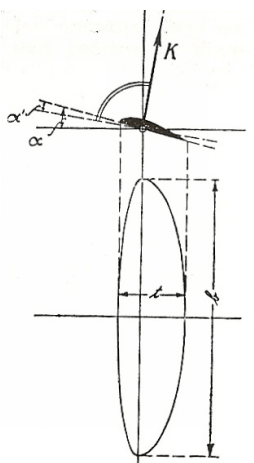

While it’s true that a tapered rectangular wing can mimic the lift distribution of an elliptical planform (especially by tailoring some twist) and also avoids most of the wetted area penalty of an untapered “Hershey-bar” wing, I still prefer the ellipse for its beauty and we’ll discuss other advantages shortly.
There are a few challenges to overcome, though.
Difficulty in fabrication. It certainly takes more effort to build this shape. We’ll be molding our wing skins, so unlike a Rutan-style massive-core composite wing, we’ll have to take more care in shaping the wing mold with a number of templates used to check the profile at various stations.
Tip stall. Like any tapered wing, the reduced chord near the tip means that the tip is operating at a lower Reynolds number than the mean aerodynamic chord, which can lead to a tendency to drop a wingtip during the stall. Also, because nearly the entire span of an elliptical wing operates at about the same lift coefficient, the stall tends to occur across the span rather than the more desirable pattern of the root stalling first.
In practice, however, airplanes like the Spitfire or Sea Fury are not known to have adverse stall characteristics, and recent research suggests that twisting a crescent-shaped wing to improve its stall behavior may not be necessary, though, as we’ll see.
Aerodynamic advantages
Two papers lend significant insights into the performance of crescent-shaped planforms:
- High Angle-of-Attack Aerodynamic Characteristics of Crescent and Elliptic Wings (NASA Research Grant NAG-1-732), by C.P. van Dam
- Wind-Tunnel Investigation of Aerodynamic Efficiency of Three Planar Elliptical Wings With Curvature of Quarter-Chord Line (NASA Technical Paper 3359), Raymond Mineck and Paul Vijgen
In summary, they found the following advantages for crescent-shaped (or straight-trailing edge elliptical) planforms:
- The highly-swept leading edge at the wing tip produces a separation-induced vortex flow at high angles of attack.The vortex flow attaches to the wingtip, delaying separation and produces:
- higher
(8% increase) compared to an unswept elliptical wing with a straight c/4 line,
- a more benign peak at stall on the
curve,
- improved post-stall lateral stability (
), and
- increased longitudinal stability at high angle of attack due to increased nose-down pitching moment.
- higher
- The improved high-alpha three-dimensional flow characteristics at the tip suggest that designing with a small Reynolds number at the tip is not actually a problem (van Dam).
- The Oswald efficiency is greater by 3% below
(e.g. cruise), corresponding to reduced induced drag.

Examples of various degrees of c/4 sweep (Mineck & Vijgen). The ellipsair planform will be in between Wing A and Wing B, with the major axis of the ellipse at about 0.85c of the root chord, resulting in a nearly straight trailing edge.

Variation in 

Variation in pitching moment vs. angle of attack (Mineck & Vijgen). Decreasing 


Oil-flow patterns (Mineck & Vijgen). The straight trailing edge wing benefits from a separation-induced vortex at the tip.
In the next post, we’ll dive deeper into wing sizing and geometry.
Leave a Reply
You must be logged in to post a comment.